
How to Check Drinking Water Quality at Home 7 Easy Methods
About the Author Rajat Bansal is a water quality specialist and Co founder at Nexus Water Purifier, with over 9 years of hands-on experience in RO purification systems, water quality assessment, and ISI-certified product development. He has tested water samples across more than 40 Indian cities and advises households and commercial clients on the right purification solutions for Indian water conditions. Nexus Water Purifier | ISI 16240:2023 Certified Manufacturer | GEM Approved
You turn on your tap, fill a glass, and drink. But do you actually know what’s in that water?
In my 9 years of testing water across Indian homes from municipal flats in Mumbai to borewell-dependent homes in Jaipur the single most common thing I’ve found is this: families assume their water is safe because it looks clear. That assumption costs them more than they realise.
Arsenic, fluoride, bacteria, and heavy metals have no colour, no smell, and no taste yet they silently affect your family’s health every single day. I’ve personally tested samples in Surat and Ahmedabad where TDS exceeded 900 mg/L, while the residents had no idea. The good news? You don’t need a laboratory to get a clear first picture.
In this guide, I’ll walk you through 7 practical methods I recommend to check your drinking water quality at home from a ₹200 TDS meter to a full certified lab test so you know exactly what your family is drinking.
Quick Fact from BIS IS 10500:2012 India’s official drinking water standard: The permissible TDS limit for drinking water is 500 mg/L. The WHO recommends below 300 mg/L. In my field experience, groundwater in cities like Jaipur and Ahmedabad routinely exceeds 800 mg/L well above both limits. 📄 Read BIS IS 10500:2012 official document → bis.gov.in
Why Testing Your Water at Home Matters
Most people assume that clear water equals safe water. After nearly a decade of field testing across India, I can tell you with confidence this is one of the most dangerous assumptions a household can make.
Here is what I have personally observed in routine water samples from Indian homes:
- Arsenic colourless, odourless, tasteless. Causes skin disease, liver damage, and cancer with long-term exposure. Found in groundwater across 21 Indian states as per CGWB data.
- Fluoride no colour, no taste. Causes dental and skeletal fluorosis. Present at dangerous levels in groundwater across 17 Indian states.
- E. coli and coliform bacteria invisible to the naked eye. Common in stored overhead tank water, especially post-monsoon. Causes severe gastrointestinal infections most dangerous for children under 5 and the elderly.
- Lead leaches from old GI pipes still common in pre-2000 constructions. Causes irreversible neurological damage in children, even at low exposure levels.
Testing your water is not paranoia. It is the same basic household health maintenance as checking your blood pressure or getting a yearly health check-up except most Indian families do the latter and not the former.
Method 1: The TDS Meter Test — Your First Line of Defence (₹200–500)

A TDS meter is a small digital pen device that measures dissolved substances in water by detecting electrical conductivity. The higher the dissolved minerals and salts, the higher the TDS reading. I personally carry one on every household water assessment I conduct it takes 30 seconds and immediately tells me whether deeper investigation is needed.
How to use it:
- Turn on the TDS meter, remove the cap, and dip the electrode end into the water
- Wait 2–3 seconds and read the display (shown in mg/L or ppm)
- Repeat for three samples: tap water, purifier output, and a packaged water bottle
- Fill a clean glass with your tap water or purifier output water
What the numbers mean — based on BIS IS 10500:2012 and WHO Guidelines:
| TDS Reading (mg/L) | Water Quality | What It Means for Your Family |
|---|---|---|
| Below 50 | Too pure | Lacks essential minerals — avoid as daily source |
| 50–150 | Excellent | Ideal for children and sensitive individuals |
| 150–300 | Very Good | Balanced minerals, great taste, WHO recommended range |
| 300–500 | Acceptable | BIS permissible limit — RO recommended |
| 500–900 | Poor | Health risk with prolonged use — purification urgent |
| Above 900 | Unacceptable | Immediate action required |
💡 Rajat’s field tip: In my experience, the most revealing test is comparing your tap water TDS to your purifier’s output TDS. If your RO purifier’s output is climbing above 250 mg/L, or approaching your input reading, the membrane needs servicing. I see this missed by 80% of households I visit.
Important limitation: TDS meters measure how much is dissolved — not what specifically is dissolved. A reading of 200 mg/L could be safe calcium or dangerous arsenic. Use TDS as a first indicator, always follow up with a full lab test annually.
Method 2: The Observation Test — Free, Takes 2 Minutes
What it detects: Physical contamination, sediment, colour, odour Difficulty: Very easy | Time: 2 minutes
Before spending money on any test kit, use your senses. This won’t catch invisible contaminants, but it identifies obvious physical problems that need immediate attention.
Colour — what to look for:
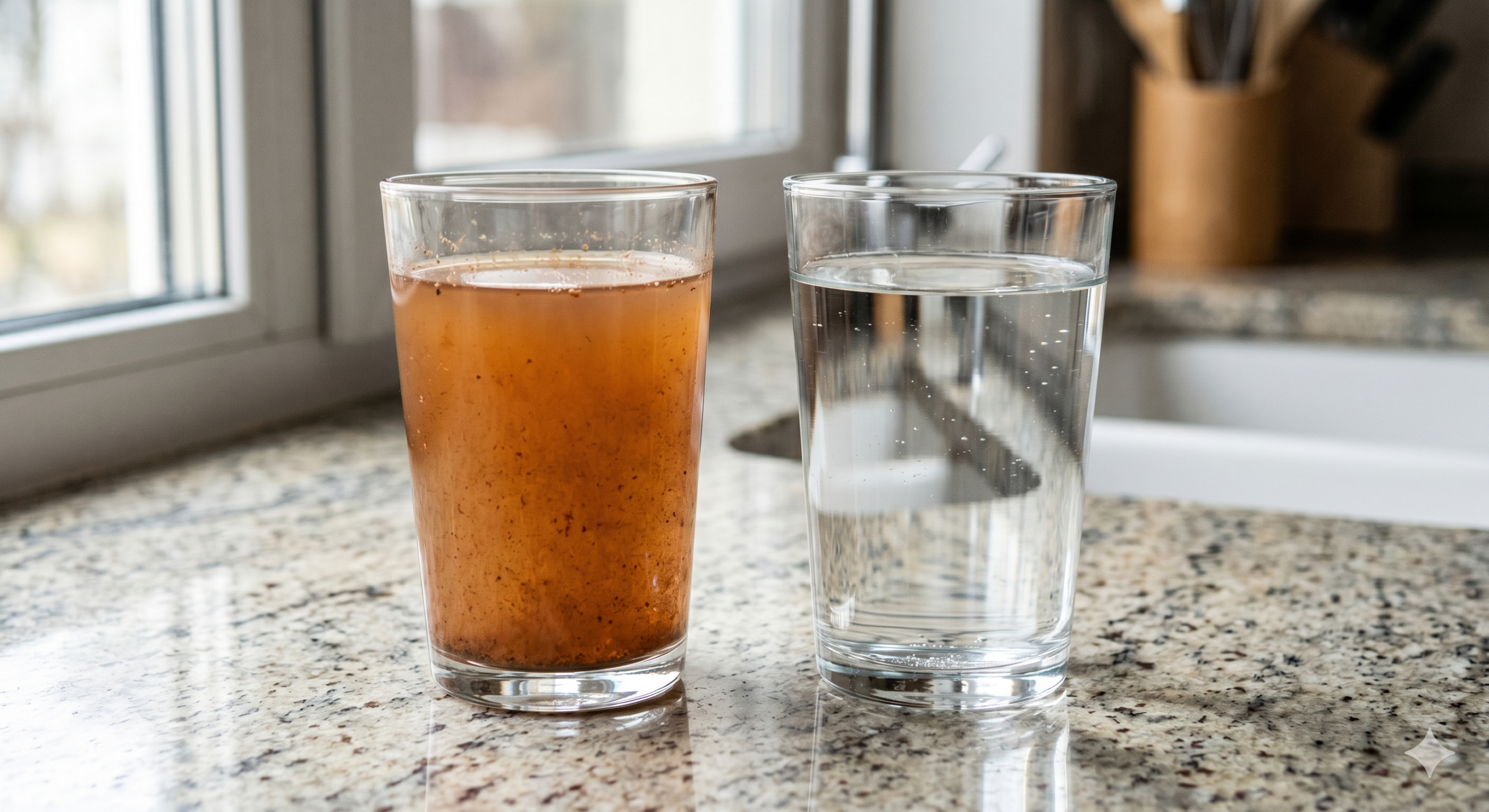
- Yellowish or brownish → rust or sediment from old pipes; common in cities with ageing infrastructure
- Bluish-green tint → copper pipe corrosion; seen more in older apartment buildings
- Milky or cloudy → either harmless air bubbles (clears in 30 seconds) OR suspended particles (investigate further)
Smell — what to look for:
- Strong chlorine smell → heavy municipal treatment; safe but unpleasant, and indicates possible trihalomethane (THM) formation
- Rotten egg / sulphur smell → hydrogen sulphide from bacterial activity in groundwater; common in borewell-dependent areas
- Earthy or musty smell → algae or organic decay in overhead tanks; a post-monsoon problem I see frequently in Surat and Mumbai
- No smell → good sign, but not a guarantee of safety at all
The Evaporation Test: Pour water on a clean dark glass or mirror surface and leave it to evaporate fully. White powdery or crusty residue left behind = high mineral content (hard water). I use this as a quick visual for clients before pulling out equipment — the thicker the deposit, the higher the dissolved solids.
Method 3: pH Test Strips — Is Your Water Too Acidic or Too Alkaline? (₹150–400)
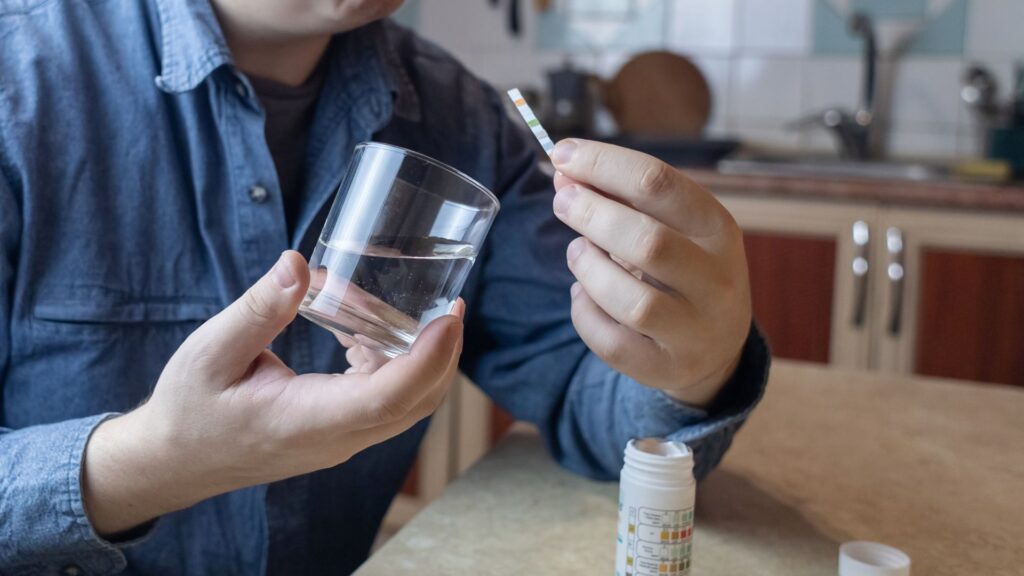
What it detects: Acidity or alkalinity level of water Difficulty: Very easy | Time: 1 minute
pH measures how acidic or alkaline your water is on a scale of 0–14. Neutral is 7. As per BIS IS 10500:2012, drinking water must fall between 6.5 and 8.5 for it to be considered safe.
How to use:
- Dip a pH strip into your water sample for 1–2 seconds
- Remove and compare the colour change against the reference chart on the packaging
What the results mean:
- Below 6.5 (Acidic): Corrosive water — actively leaches metals like lead and copper from pipes directly into your drinking water. I’ve seen this in industrial areas of Gujarat and Punjab. Do not ignore this result.
- 6.5–8.5 (Ideal range): Safe per BIS standards
- Above 8.5 (Alkaline): Often indicates high mineral content. Not immediately harmful but warrants investigation. Natural alkalinity is different from the controlled, beneficial alkalinity produced by an alkaline purifier cartridge.
💡 Rajat’s note: A lot of my clients confuse naturally high pH water with “healthy alkaline water.” High natural pH caused by dissolved minerals like calcium carbonate is not the same as the ionised alkaline water from a quality alkaline cartridge. The former can still carry harmful minerals — always test for both pH and TDS together.
Method 4: The Hardness Test — Are You Living With Hard Water? (₹200–600)
What it detects: Calcium and magnesium concentration (water hardness) Difficulty: Easy | Time: 2–3 minutes
Hard water is one of the most widespread and most ignored water problems across India — particularly in Gujarat, Rajasthan, Haryana, and Delhi NCR. In my field visits to homes in Jaipur and Ahmedabad, I routinely measure hardness above 400 mg/L — nearly double the BIS acceptable limit of 200 mg/L.
The Free Soap Test (no kit needed):
- Fill a clean transparent bottle halfway with your tap water
- Add 10 drops of pure liquid soap (not detergent)
- Close the bottle and shake hard for 10 seconds
- Observe for 30 seconds
- Lots of bubbles + clear water below = Soft water (low hardness — good)
- Few or no bubbles + milky, cloudy water = Hard water (high calcium/magnesium — investigate)
What BIS says:
| Hardness (mg/L as CaCO₃) | Classification | BIS Status |
|---|---|---|
| 0–75 | Soft | Ideal |
| 75–200 | Moderately Hard | Acceptable limit |
| 200–300 | Hard | Permissible limit |
| Above 300 | Very Hard | Exceeds BIS permissible limit |
Chronic consumption of very hard water (above 300 mg/L) is associated with increased kidney stone risk. It also causes heavy scale buildup in geysers, washing machines, and overhead tanks — shortening appliance lifespan significantly.
Method 5: Chlorine Test Strips — Is Your Municipal Water Over-Treated? (₹150–400)
What it detects: Free chlorine and total chlorine levels Difficulty: Easy | Time: 1 minute
Municipal water supplies in India use chlorine for disinfection — which is essential to kill bacteria. However, when chlorine reacts with organic matter present in water (leaves, sediment, algae), it forms compounds called trihalomethanes (THMs), which are classified as potential carcinogens by the WHO with prolonged exposure.
Safe chlorine range per BIS IS 10500:2012: 0.2–1.0 mg/L
How to test: Dip the strip for 2 seconds and compare colour against the chart.
- Below 0.2 mg/L — Under-treated; bacterial contamination risk. Common in areas at the tail end of municipal pipelines.
- 0.2–1.0 mg/L — Safe range per BIS
- Above 1.0 mg/L — Over-chlorinated; affects taste and may contribute to THM formation
💡 Rajat’s tip: If your water smells strongly of chlorine — especially in the morning when water has been sitting in pipes overnight — your first action should be running the tap for 60 seconds before using it. Better still, a quality activated carbon filter (present in all multi-stage Nexus purifiers) removes chlorine and THMs effectively at the pre-filtration stage.
Method 6: Home Water Testing Kit — 9 Parameters in One Box (₹500–2,000)
What it detects: Multiple parameters — bacteria indicators, nitrates, chlorine, pH, hardness, iron, and more Difficulty: Easy to moderate | Time: 15–30 minutes
Home water testing kits are multi-parameter solutions that come with chemical reagents or test strips covering 9–16 different contaminants. They are a significant step up from individual strips and give you a broader picture in one session.
What a good quality kit should cover:
- TDS, pH, total hardness
- Free chlorine and total chlorine
- Iron and manganese
- Nitrates and nitrites (critical for agricultural areas and homes near farms)
- Coliform indicator (basic bacterial screen)
Where to buy in India: Search “home water testing kit” on Amazon.in or Flipkart. Look for kits that specifically mention BIS or NSF compliance and cover at least 10 parameters.
Rajat’s honest assessment: Home kits are excellent for household screening and give you a genuinely useful snapshot of your water. However, they are not precise enough to rely on for actionable health decisions. If a home kit flags anything — nitrates, high iron, or coliform presence — escalate immediately to a certified laboratory test. Don’t wait.
Method 7: Professional NABL-Certified Laboratory Test — The Gold Standard (₹500–3,000)

What it detects: Everything — including arsenic, fluoride, lead, E. coli, pesticides, heavy metals, and virological parameters Difficulty: Easy (just collect and submit a sample) | Time: 3–7 working days for results
This is the definitive water test. A National Accreditation Board for Testing and Calibration Laboratories (NABL) certified water testing lab gives you a complete chemical and microbiological analysis — the kind of data that can genuinely guide your purification and health decisions.
I recommend every Indian household get a full lab test at least once a year — and always after monsoon season, when groundwater contamination risk spikes.
How to get your water tested:
- Search “NABL accredited water testing lab near me” on Google — most cities have at least one
- The lab provides a sterile sample collection bottle with precise instructions
- Collect your sample from the tap you drink from most frequently, letting it run for 30 seconds first to flush standing pipe water
- Submit the sample — detailed results arrive in 3–7 working days
What to specifically request they test for:
- Microbiological: Total coliform, E. coli, faecal coliform
- Chemical: TDS, pH, total hardness, chlorides, fluoride, nitrates, iron, sulphates
- Heavy metals: Lead, arsenic, chromium, cadmium, mercury
- Pesticides: Essential if you live in or near agricultural areas (Punjab, Haryana, UP, Maharashtra)
💡 Free testing options: Many state governments and municipal corporations offer free water testing. The Central Ground Water Board (CGWB) also periodically conducts free groundwater testing camps. Check your local municipal corporation website or call your nearest CGWB regional office.
What to Do After Testing — Rajat’s Action Guide
Based on what I recommend to every household I assess:
| Problem Found | Immediate Action | Long-Term Solution |
|---|---|---|
| TDS above 500 mg/L | Stop drinking directly; use bottled water temporarily | RO purifier with TDS controller |
| E. coli / bacteria detected | Boil all water immediately | RO + UV multi-stage purifier |
| High chlorine (above 1.0 mg/L) | Run tap 60 seconds before use | Activated carbon pre-filter |
| Very hard water (above 300 mg/L) | Use packaged water short-term | RO removes hardness effectively |
| High fluoride detected | Switch to packaged water immediately | RO membrane removes fluoride up to 95% |
| High iron / rust | Check and replace old GI pipes | Sediment + carbon pre-filter |
| Low pH / acidic water | Do not drink — leaches pipe metals | Alkaline filter or full RO system |
How Often Should You Test Your Water?
This is what I recommend based on water source:
- Every 6 months — municipal supply users
- Every 3 months — borewell or groundwater users
- Every month — if you have children under 5 or elderly family members at home
- Immediately after monsoon — groundwater quality drops significantly every year due to surface runoff contamination
- After any nearby construction — drilling and excavation disturbs groundwater tables, sometimes severely
Boiling kills bacteria and viruses effectively — but it does not remove dissolved chemicals, heavy metals, fluoride, arsenic, nitrates, or TDS. It also concentrates dissolved solids by evaporating the water itself. Boiling is a useful emergency measure, not a complete long-term purification solution. I explain this to almost every new client.
Not always. Packaged water quality varies widely by brand and batch, and is not tested in real time. Long-term storage in PET plastic bottles introduces microplastic contamination. A well-maintained home purifier certified to BIS ISI 16240:2023 provides more consistent, tested quality at a fraction of the long-term cost.
Without question, yes. The most dangerous contaminants in Indian water — arsenic, fluoride, nitrates, E. coli — are all colourless and odourless. I have personally tested water samples that looked perfectly clean and returned arsenic readings three times above the permissible limit. Clear water is not a safety guarantee.
Test the purifier output with a TDS meter every 3 months. Get a full lab test of the output water annually. If output TDS is rising consistently or approaching your input levels, your RO membrane needs immediate servicing. Most membranes last 12–18 months under typical Indian water conditions.
In most parts of India, no — not without testing first. Borewell groundwater frequently contains naturally occurring fluoride, arsenic, nitrates, and very high hardness, depending on your region. Always get borewell water independently tested by a NABL-certified lab before using it as a drinking source. This is one of the most common mistakes I see in semi-urban and rural households.
The Bottom Line — From the Field
After 9 years of testing water across more than 40 Indian cities, my message to every household is simple: your water is not as safe as it looks.
Here is the testing routine I recommend to every family:
- Buy a TDS meter (₹300) — test monthly, 30 seconds per test
- Use pH strips (₹200) — test quarterly
- Run a home multi-parameter kit — once every 6 months
- Get a full NABL lab test — once a year, always after monsoon
Knowledge costs ₹300 and 30 seconds. The health consequences of ignoring it can last years.
Is Your Water Raising a Red Flag? Nexus Can Help.
If your test results show high TDS, bacterial contamination, heavy metals, or hardness — the right RO purifier is your most reliable, cost-effective long-term solution. At Nexus Water Purifier, every model is ISI 16240:2023 certified and engineered specifically for Indian water conditions — not generic lab water.
Our certified technicians also offer a free water quality assessment for your home — including TDS, pH, and microbial screening — before recommending any product.
Related Reads from Nexus
- What is TDS in Water? Safe TDS Levels for Drinking Water in India →
- RO vs UV vs UF — Which Water Purifier Technology is Right for Your City? →